
A Visual Feast
Whatever our souls are made of

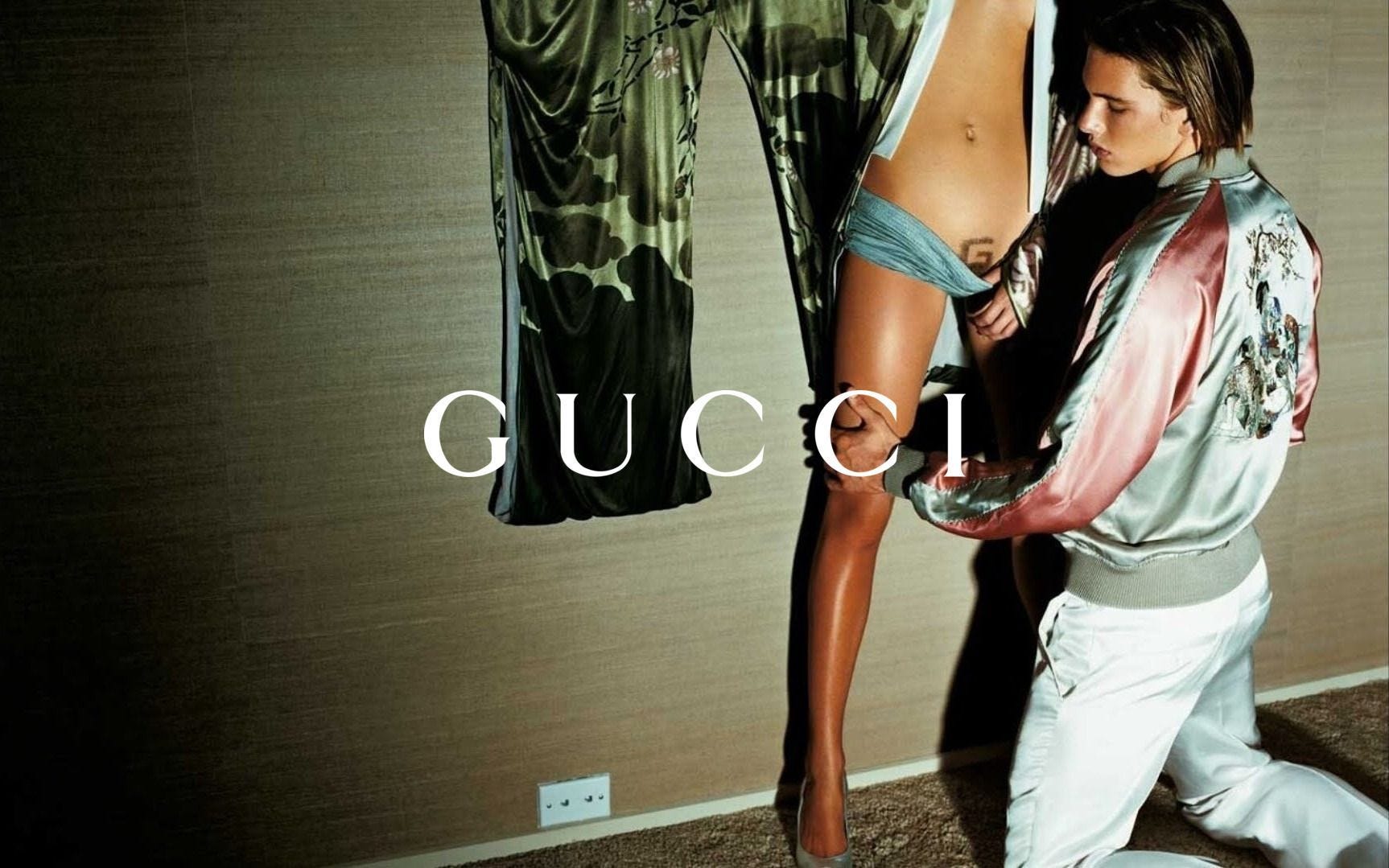
There’s a popular poster I enjoy on Instagram by the name of Kay Poyer (ladymisskay_). Several weeks ago during fashion week, she posted about the Gucci show that took place in Milan, a notable one because it was creative director Demna’s first show for the brand. Miss Kay is into fashion, and she posted a series of stories I haven’t stopped thinking about. They weren’t about the clothes.
Her point (I’m paraphrasing, because her words have disappeared, as words contained within Instagram stories tend to do) was essentially that the type of sexiness showcased on the runway (and integral to Gucci’s brand in general - slutty!) doesn’t feel genuine anymore, because to find hard nipples poking through a shirt sexy, or to find a dress with a built-in, exposed thong sexy, you have to find the human body itself sexy, and culturally, she’s not sure ‘we’ still do. At least, a lot of us no longer do.
This line of thinking posed to me a scintillating question. If no one is interested in the body anymore, why are we still selling sex the old-fashioned way?
Perhaps it’s just a biological habit, to look at reproductive parts and apply a sexual meaning to them. Maybe we lack the imagination necessary to envision what could come next. Certainly, the folks over at r/MyBoyfriendisIsAi are not shackled by the chains of such small-mindedness. They are coding scenes with Claude. They are finding ways to hack their sex toys so that they can be synced with the bespoke script the tool is generating for them that day, that hour. It’s custom content from a personality that is uniquely for them and them alone, rather than designed for a blunted ‘audience’ whose rarefied kinks the author might not be aware of.
Part of ladymisskay_’s theory that we’re over the body, over people in general, referenced an increasingly normalized behavior among clients who see her for sex work. Namely, they’re sending over 4-6 page pdfs in advance of the meeting, containing hyperspecific instructions for the scene they’d like to have. This work (what else could you call it?) is required preproduction for many to manage a halfway decent orgasm. Follow this prompt. Say these words. Do these actions. Wear this. And act like I never asked you to do any of it, act naturally. Even in sexual acts occurring between two humans, we’re inching ever closer to a place of recipe, away from instinct.
What comes naturally to an LLM? My biggest question: are the ladies of /MyBoyfriendisAI even imagining a human male when they’re getting dirty-talked by Claude? I’m dangerously sure that they’re not, that pretty soon, that kind of fantasy might totally die out among the AI-centric. We say this can’t happen, when in many ways it already has. Gen Z is having less sex than any generation that came before them, all while contraception is more available than ever. It’s not fear of disease or pregnancy that is stopping them, they’re just not interested. Too much danger, too many smells, too intimate, too confronting. They want the output of intimacy without the improvisation. Now that there are ways to gather a semblance of that via technology, older generations are interested as well.
This burgeoning American distaste for real intimacy was on excruciating display in Emerald Fennell’s latest film, Wuthering Heights. Now, early readers of this newsletter may recall my visceral hatred for the movie Promising Young Woman. Before I go any further, I want to make it clear that I did not spend a cent watching Wuthering Heights. Not during its staggeringly huge opening weekend, or in the well-performing weeks after. Not when I walked through the West Village for a dental appointment and heard not one, not two, but three separate women describe it rapturously to their companion as ‘a visual feast’, in those exact words. Where did they all read that specific phrase and decide to use it to describe, of all things, this movie? Surely they did not read it in the scathing NYT review (which filled my heart with song).
First of all, I am aware that this movie was supposed to be sexy, not quality. I’m not gatekeeping the book. Truth be told, I don’t particularly care for the novel, or for the Bronte sisters. The problem is it wasn’t sexy at all. Your grandmother binges infinitely hotter episodes of Bridgerton at three in the afternoon. And sure, Bridgerton is a genius program helmed by an icon who masterfully understands how to show the audience what is happening instead of telling us. That’s something every artist knows is key to crafting an engaging narrative. Beyond craft, Bridgerton has something to say. I’m not sure that current studio heads realize that having something to say in the first place is integral to being able to show it.
Wuthering Heights is a film designed to make people feel aroused; instead it made them admire big budget aesthetics. The problem I have is that nobody seems to be noticing that there is a difference between those two things.
I cannot remember the last time I walked away from a movie feeling so empty. All there is to talk about are the visuals, which is the only reason they made the movie. It runs like one long perfume ad, no real plot, no sense of place or time, dry, airless and soulless. While many compared the fashion and ‘aesthetic’ (this is the word TikTokers use when they mean ‘creative direction’) to Sofia Coppola’s Marie Antoinette, I saw zero evidence of that film’s DNA outside of some comically large prop fruit. Coppola gave Marie a personality. She let us see the parts of her fictional personality that we might have found compelling had we known her. Yes, it was campy, yes, it broke many period piece rules with the soundtrack, but at its core it was about an individual girl who happened to find herself on the throne. I still do not know what Wuthering Heights was about, other than the objective physical perfection of its leads.
When the ‘hottest’ moment of a movie made exclusively to showcase hotness is the protagonist putting her hands into a huge guy’s mouth, we’ve got a problem. Watching it, I couldn’t help but think about the recent reception of One Battle After Another, how the main takeaway from the audience for weeks was about how ‘well-paced’ it was, and that it ‘didn’t feel like 3 hours.’ If we’re walking out of movies talking about pacing instead of narrative, the movie isn’t good. I’m not at the movies for a magic trick. Judging by box office numbers, the general movie-going population appears to have collectively forgotten that the point of art itself is to feel something. Not to make time go by faster or be visually pleased, but to feel something deeply, and above all to empathize with characters going through a human experience.
Fennell has been consistent across interviews about what she was going for: “I wanted to make something that made me feel like I felt when I first read it, which means that it’s an emotional response to something. It’s, like, primal, sexual,” she told the BBC. Her stated intention was to “recreate the feeling of a teenage girl reading this book for the first time.”
Fine. I’ll accept that premise. But if your film is actually about a teenage girl reading a book, about the interiority of that experience, the private, illicit, personalized fantasy of it, then you need to put that girl in the movie. You need a frame. You need a Princess Bride, a story within the story, a sibling’s voice, a girl investigating her mother’s bookshelf for the first time. Without a clear entry point, what you’ve made isn’t a love letter to a reader’s imagination, it’s just the fantasy itself. The point of view is unmoored to the flavor of teen hood, expected to work on an audience that wasn’t there when you were fourteen and never will be.
I’m not sure a reality where sex workers are pre-reading PDFs and women are spending hours building AI boyfriends is not a place I want to be living. I worry that much of the population may take Fennell’s approach: retreating into the fantasy we had at fourteen, perfecting it, and protecting it from the contamination of other people’s desires. The trouble is that’s exactly what art is supposed to do in reverse: take the private thing and make it land in a stranger’s chest. When you forget that other people exist, you don't just make bad erotica. You make art that asks nothing of the audience because, somewhere along the way, you forgot the audience was even there.
Now go watch Hamnet, and remember what the theater is for.